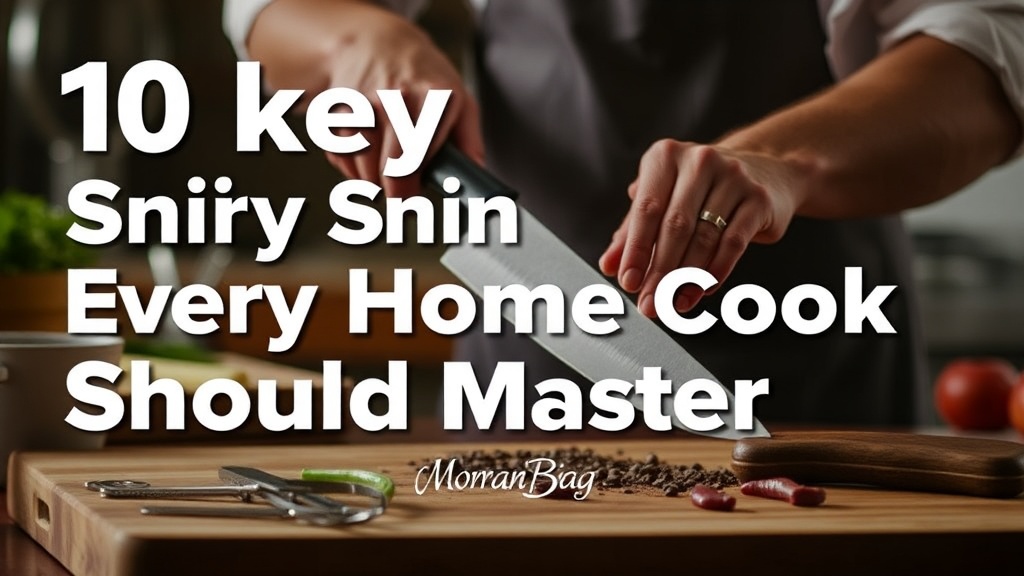
10 key Knife Skills Every Home Cook Should Master

The Claw Grip: Protecting Your Fingers While Chopping
The Perfect Dice: Uniform Cubes for Even Cooking
Julienne Cuts: Creating Matchstick Vegetables Like a Pro
The Rock Chop: Efficient Herbs and Aromatics Mincing
Bias Cuts: Adding Visual Appeal and Texture to Dishes
Sharp knife skills separate home cooks who struggle from those who move through the kitchen with confidence. This guide covers the ten fundamental cutting techniques that transform prep work from a chore into something almost meditative — from the basic claw grip to breaking down whole chickens. Master these, and you'll cut your prep time in half while keeping all ten fingers intact.
What's the Most Important Knife Skill for Beginners?
The claw grip isn't glamorous, but it's the foundation everything else builds on. Without it, you're working slower — and risking a trip to the emergency room.
Here's how it works: tuck your fingertips inward, curling them under your knuckles. The knife blade rests against your middle knuckle, guiding each cut. Your fingertips stay safely behind the blade's path while your knuckles act as a ruler for consistent pieces. It feels awkward at first. Most beginners want to extend their index finger along the blade's spine (the "pointer grip" — don't do it). Give yourself three or four sessions. Muscle memory kicks in faster than you'd expect.
Professional kitchens drill this grip because it scales. Whether you're mincing garlic or slicing through a butternut squash, the mechanics stay identical. Serious Eats has an excellent photo breakdown if you're a visual learner.
The beauty of the claw grip? It works with any knife — your grandmother's carbon steel blade or a basic Victorinox Fibrox from the restaurant supply store.
How Do You Chop an Onion Without Crying?
The technique matters more than the goggles. A proper dice — root intact, horizontal slices, then vertical cuts — keeps cell walls intact and minimizes the fumes that make you weep.
Start with a sharp knife. Dull blades crush rather than slice, rupturing more cells and releasing more of those irritating sulfur compounds. Cut the onion in half through the root and peel. Make horizontal cuts toward the root (but not through it), then vertical cuts, then crosswise chops. The root holds everything together until the final moment.
That said, some onion varieties are simply more aggressive. Spring onions and Vidalias gentler than storage onions. A chilled onion releases fewer fumes — ten minutes in the freezer before cutting helps. So does a well-ventilated workspace.
The dice you produce should be reasonably uniform. Perfect cubes aren't the goal; consistent sizing is. Pieces that cook at the same rate make better food. A ragout with some onion bits caramelized and others still raw? That's a technique problem, not a recipe problem.
What's the Difference Between a Julienne and a Brunoise?
Julienne creates matchsticks; brunoise creates tiny cubes. The brunoise is simply a julienne turned sideways and diced fine. These "precision cuts" originated in classical French kitchens — but they're practical tools, not just culinary heritage.
Julienne (3mm × 3mm × 4cm) works for stir-fries, slaws, and garnishes. Brunoise (3mm cubes) suits stuffings, sauces, and fine vegetable preparations. There's also the larger macédoine (5mm cubes) and the finer paysanne (thin, irregular squares — more rustic, less rigid).
Here's the thing about these cuts: they demand the same grip and motion every time. The knife tip stays anchored to the board. The blade rocks forward through the vegetable while your non-knife hand advances at a fixed interval. Consistency comes from body mechanics, not obsessive measuring.
| Cut Name | Dimensions | Best Uses |
|---|---|---|
| Brunoise | 3mm cube | Stuffings, consommé garnish, fine sauces |
| Macédoine | 5mm cube | Vegetable salads, composed dishes |
| Julienne | 3mm × 3mm × 4cm | Stir-fries, slaws, spring rolls |
| Batonnet | 6mm × 6mm × 6cm | Vegetable sticks, crudités, fries prep |
| Paysanne | Thin, flat squares | Rustic soups, braises, home cooking |
Don't get intimidated by the French terminology. A professional kitchen needs precise language — ten cooks working the same station need to communicate clearly. At home? Call them "tiny cubes" if you prefer. The technique matters; the vocabulary doesn't.
Why Does a Sharp Knife Actually Cause Fewer Injuries?
Sharp knives cut predictably. Dull knives slip, skid, and require more force — all recipes for accidents. A blade that glides through a tomato's skin without pressure is safer than one that demands a sawing motion.
The catch? Most home cooks wait too long to sharpen. Honing (running the blade along a steel rod) realigns the edge but doesn't sharpen it. True sharpening — removing metal to create a new edge — happens on stones or with professional services.
A Shun Classic 8-inch chef's knife fresh from the factory can slice paper-thin sheets from a magazine. That same knife, six months of daily use without maintenance, struggles with a bell pepper. The difference isn't the knife — it's the edge.
Learn to use a whetstone. Start with a 1000-grit stone for repairs and a 3000-6000 grit for polishing. Soak the stone, maintain a consistent 15-20 degree angle, and work slowly. Twenty minutes once a month beats emergency room visits.
How Do You Mince Garlic Properly?
The paste method — salt, pressure, and repetition — yields finer, more flavorful results than simple chopping. Salt acts as an abrasive, breaking down cell walls and creating a smooth purée rather than chopped bits.
Peel your cloves. (The flat-of-knife smash technique works — though it bruises the garlic slightly, which matters for raw applications.) Mince roughly, then sprinkle with coarse salt. Drag the blade across the garlic at a 15-degree angle, pressing down and forward. Scrape, gather, repeat. The garlic transforms from distinct pieces to sticky paste in about thirty seconds.
Worth noting: this paste dissolves into oil instantly. No floating bits, no bitter burned chunks. For aglio e olio or Caesar dressing, this matters. For a braise that cooks for three hours? Rough chop is fine. Match the technique to the dish.
What's the Best Way to Slice Meat Against the Grain?
Look for the direction of the muscle fibers — the "grain" — and cut perpendicular to them. This shortens the fibers, making each bite more tender. With the grain, you're chewing through long, intact strands.
Flank steak demonstrates this perfectly. The grain runs lengthwise, obvious to the eye. Slice straight across (bias-cut, 45-degree angle for wider slices) and the meat yields easily. Slice with the grain and even the best-cooked steak becomes chewy.
For poultry, the principle holds but the grain is subtler. Chicken breast fibers run roughly lengthwise — slice crosswise for cutlets. Whole roasted birds are different; the grain direction changes across different muscles. Take a moment before cutting. Look. The muscle structure tells you exactly where to place your blade.
Partially frozen meat slices cleaner. Fifteen minutes in the freezer firms up the texture without freezing solid. This is how restaurants achieve those paper-thin beef slices for hot pot or pho.
How Do You Break Down a Whole Chicken?
Work at the joints, not through bone. A chicken's anatomy provides natural separation points — your knife finds the gaps between bones with minimal resistance.
Start with the legs. Cut the skin between thigh and breast, then bend the leg backward until the hip joint pops. Cut around the joint, not through bone. Repeat on the other side. For the breasts, run the knife along the breastbone, keeping the blade tight to the rib cage. The wings separate at the joint — find the gap, cut through.
A whole bird costs roughly half what pre-cut pieces run. More importantly, you get the backbone for stock — the foundation of risotto, pan sauces, and soups. Jacques Pépin's technique video remains the gold standard for visual learners.
The same principles apply to fish filleting. Find the spine, work along the ribs, let the knife follow bone structure rather than forcing through it. Practice on inexpensive tilapia before attempting a $30 side of salmon.
What's the Proper Technique for Chopping Herbs?
Bunch, curl fingers, rocking motion — never the food processor bruising everything into oxidation. Fresh herbs are volatile; cutting ruptures cells and releases aromatic compounds you want to preserve.
Wash and dry thoroughly first. Wet herbs stick, slide, and bruise. Gather into a tight bundle (the chiffonade technique for basil — stacked leaves rolled into a cigar — works for any leafy herb). Rock the blade through with the tip anchored, moving backward through the bundle. Two or three passes, max. Over-chopping bruises the edges, darkening the herbs and muddying the flavor.
Woodier herbs — rosemary, thyme, sage — need different treatment. Strip leaves from stems (run fingers backward along the stem against the growth direction), then chop. The stems are bitter; don't include them unless you're making stock.
How Do You Maintain Your Knives Between Sharpenings?
Proper storage, immediate cleaning, and regular honing extend edge life dramatically. A knife banging around in a drawer loses its edge in weeks. The same knife, stored on a magnetic strip or in a blade guard, holds its edge for months.
Never put good knives in the dishwasher. The heat, harsh detergent, and knocking against other items damages edges and handles. Hand wash immediately after use, dry completely, store properly. Carbon steel blades (like those from Korin in Manhattan) need oiling to prevent rust — they're higher maintenance but take a keener edge than stainless.
Steel honing before each use realigns the microscopic teeth along the blade's edge. Five strokes per side, alternating, blade at 15 degrees to the steel. It takes ten seconds and maintains the edge between proper sharpenings.
A cutting board matters too. Glass, marble, and hard plastics dull blades. End-grain wood or soft plastic (the OXO Good Grips cutting boards are excellent) cushions the edge. Think of your knife and board as a system — they work together or against each other.
Which Knife Skills Transfer Across Cuisines?
The fundamentals — grip, blade control, working with ingredient structure — apply universally. Whether you're julienning carrots for Vietnamese nộm or brunoising mirepoix for French sauce, the mechanics don't change.
That said, different traditions emphasize different skills. Japanese cuisine prizes precise vegetable cuts for presentation. Chinese wok cooking demands uniform pieces that cook simultaneously over intense heat. Mexican molcajete cooking requires rough, textured chopping rather than fine precision.
The knife skills in this post travel. A cook who can break down a chicken can tackle Thai laab, Peruvian pollo a la brasa, or Jewish-style chicken soup. The blade becomes an extension of your hand — a tool for understanding ingredients at their most fundamental level.
Pick one technique. Practice it deliberately for a week. The investment pays dividends across every cuisine you'll ever cook.
"A recipe has no soul. You, as the cook, must bring soul to the recipe."
Your knife skills are how that soul enters the food — through precision, respect for the ingredient, and the confidence that comes from knowing your tools.