The Women Who Held the Flavor: Why We Forgot Female Chefs Built Everything We Eat
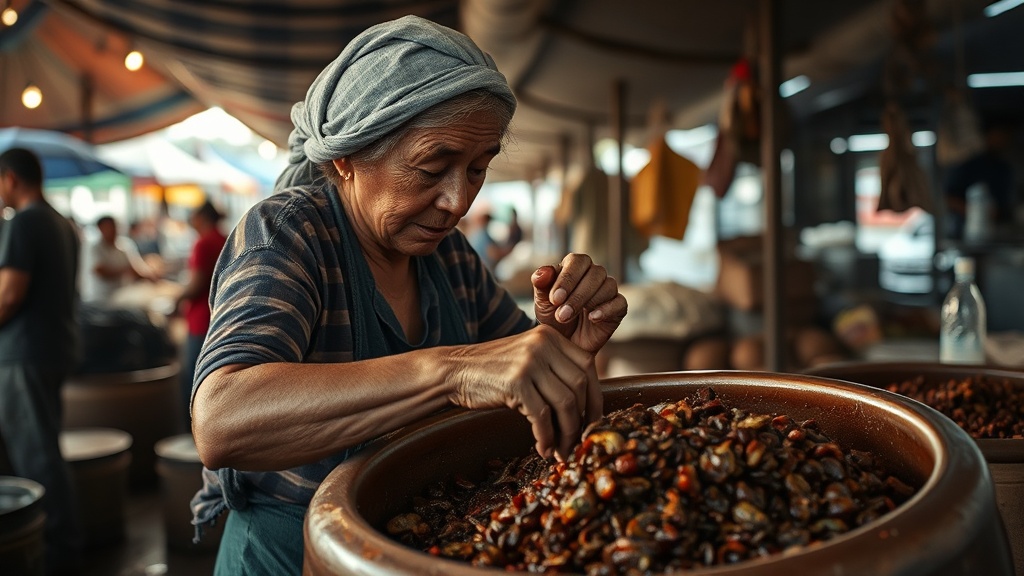
I want to tell you about a woman I met in Chiang Mai whose name I never got.
She was maybe sixty-five, running a market stall at five in the morning, and she was making a fermented shrimp paste — kapi — the same way it's been made in northern Thailand for longer than anyone in that market could trace. She had a rhythm. The smell was extraordinary: pungent and oceanic and somehow alive. I asked her, through a translator who was maybe half-engaged, how she learned it. She said her mother. Her mother's mother before that.
I asked if anyone had ever written it down.
She looked at me like that was the strangest question she'd ever heard.
Here's the thing I couldn't stop thinking about on the flight home: the version of that paste that shows up in a Bangkok fine dining restaurant — the one that gets reviewed, photographed, described in careful tasting notes by a male chef who calls it "a study in fermentation" — that version is credited to him. The woman at five in the morning is credited to nobody. She's the "tradition." He's the "master."
That's not a glass ceiling. That's an erasure. And it runs through a lot of the written history of food.
The Problem Isn't Just the Kitchen Hierarchy — It's the Archive
When colonizers and administrators documented food cultures around the world, they often worked through a built-in filter: they talked to men. They visited courts and restaurants and formal culinary institutions — places men ran. They rarely documented market stalls. They rarely documented home kitchens. They rarely sat with the women doing the actual work of feeding families, neighborhoods, cities.
So the archive reflects that bias. What got written down looks official. What happened in kitchens run by women got called "folk knowledge" — which, in academic and culinary circles, is one small step above not knowing anything at all.
The professional kitchen then became the place where "real" culinary authority was certified. And we know who was allowed into professional kitchens. We know whose labor was valued there. The kitchen brigade system — popularized by Escoffier, still floating around in culinary schools like it's natural law — was explicitly modeled on military hierarchy. It was, almost by design, hostile to the knowledge systems women had developed outside it.
So here's the pattern that food scholars like Krishnendu Ray and Psyche Williams-Forson have traced: women often held the actual knowledge. Men built the institutions that certified knowledge. And then the institutions started telling us who the authorities were.
Case Study: Mole, and the Women Who Didn't Get Credit
Mole is not a recipe. If you think it's a recipe, you've already misunderstood it.
Mole is generational technology. It's hundreds of small decisions accumulated over lifetimes — which chiles, in what ratio, toasted how long, with what kind of chocolate, what thickness, rested how many days. Historian Jeffrey Pilcher's research into Mexican culinary identity traces how, in Oaxaca and Puebla and the Valle de México, that accumulated knowledge has been held and transmitted primarily through women — grandmothers who tasted it, adjusted, tasted again. Families with their own regional variations that represent real intellectual labor, real creative refinement, real culinary knowledge.
When mole enters fine dining — when a male chef in a white-tablecloth restaurant in New York or Mexico City puts mole negro on the menu — something quietly shifts. The chef "interprets" the tradition. The chef "pays homage" to the tradition. Food media writes about the chef's "mastery" of the tradition. The women who are the tradition become the backdrop. They get called "home cooks." They get called the "authentic source" he drew from — which sounds like credit but isn't, because it doesn't attach a name, a history, or a paycheck to anyone.
I'm not saying those chefs are bad people. I'm saying that the structure we've built to evaluate culinary authority doesn't see women's labor as authority. It sees it as raw material.
Case Study: Southeast Asian Fermentation, "Discovered" by Men
The woman in Chiang Mai isn't an outlier. She may not be the exception.
Fish sauce — nam pla in Thailand, nước mắm in Vietnam, tuk trey in Cambodia — is the backbone of Southeast Asian cuisine. (A clarification worth making here, because I've seen this mangled in food writing: nước chấm is the condiment you dip your spring rolls in — fish sauce cut with lime, sugar, sometimes chili — not the fish sauce itself. And Cambodia's fermented fish paste, prahok, is a distinct technology from fish sauce, though equally ancient, equally significant, and by most historical accounts equally female-transmitted.) These fermented products represent some of the oldest preserved food technologies in human history, with documented roots going back thousands of years. Food anthropologists who've studied the region — drawing on work from scholars like Sidney Mintz on flavor principles — suggest that in domestic and market contexts, where most production actually happened, this knowledge was predominantly held and passed down by women.
For most of culinary history, this knowledge was oral. It was transmitted through demonstration, through watching and tasting and adjusting. It wasn't measured. "Unmeasured" is a word food historians have used about women's culinary traditions, and I want to sit with how loaded that is — because in academic and culinary contexts, "unmeasured" is a shorthand for "not rigorous." The assumption is that if you can't quantify something, you don't truly understand it.
Then male chefs started measuring it. Started running controlled fermentation experiments. Started writing it down in the language of food science. And suddenly it became a "discovery." Suddenly it became expertise. Suddenly it became something worth crediting — and the credit went to the men doing the measuring, not the women who spent generations building the knowledge base they were measuring.
I find this infuriating. I was a history teacher. I know what it looks like when the archive gets written by people with power. This is what it looks like.
Case Study: West African Palm Oil Kitchens
The culinary knowledge embedded in West African cooking is extraordinary in its sophistication. Palm oil, fermented locust beans, the careful layering of egusi seeds, the patience required for a proper ofe onugbu — this is not simple food. It's complex, regionally specific, deeply technical cooking. Scholars like Psyche Williams-Forson, who has written extensively on Black women's food labor and knowledge, have documented how this knowledge has historically been held and transmitted by women across the region — across Ghana, Nigeria, Cameroon, and beyond — in ways that rarely made it into written culinary records.
When that food enters fine dining — when a male chef opens a restaurant in London or Lagos or New York that "elevates" West African cuisine — the framing tends to go one of two ways. Either it's presented as an "interpretation" of tradition (the chef becomes the authority, the tradition becomes the source material), or it's framed as "bringing ethnic cuisine to fine dining" (which implies that before the chef did this, the cuisine wasn't quite fully realized).
Both framings can erase the women who made those techniques. The grandmothers who calibrated their palm oil temperatures by feel. The market vendors who developed the spice blends that define their regions. The knowledge systems that were passed down not because they were written anywhere but because they worked — because they produced extraordinary food that sustained communities.
That knowledge is worth naming. The people who built it are worth naming.
Why 2026 Is the Right Moment to Ask These Questions
International Women's Day comes around every March 8th, and every year the food industry does its version of celebration: female chef spotlights, profiles of women breaking barriers, features on the hard work of getting into kitchens where you weren't wanted.
And those stories matter. The barriers are real. The discrimination is real. The women who fought through professional kitchen culture to claim authority they deserved — they're worth celebrating.
But I keep thinking about a different set of women. The ones for whom "breaking barriers" isn't the story because the barriers weren't into formal kitchens — they were around formal kitchens. The women whose labor built the traditions that professional kitchens now draw on and get credited for. The woman in Chiang Mai who knew more about fermentation than most chefs who write about fermentation ever will. The mole families whose knowledge is described as "authentic tradition" in the same sentence that credits a male chef for "mastering" it.
How we tell culinary history shapes who gets paid. Who owns recipes. Who gets a cookbook deal and who gets called a home cook. Who gets called a master and who gets called a background.
The uncomfortable question I can't shake is this: what does it do to your understanding of "great cuisine" if you reverse the equation? If you start with the assumption that much of the foundational knowledge was held by women — that the refinement happened over generations in kitchens that never made it into any archive — and you ask who, exactly, male chefs are being credited with "mastering"?
The answer, a lot of the time, is: each other.
I think about that woman in Chiang Mai a lot. I don't know her name. That's the problem. Not the glass ceiling of professional kitchens — that's real, but it's downstream of something older and more structural. The problem is that we built an entire system for crediting culinary knowledge that was designed, from the start, to make her invisible.
She knew things. She knew things nobody else in that market knew the same way she knew them, because she had spent a lifetime learning them from someone who spent a lifetime learning them. That's expertise. That's intellectual history.
The least we can do is call it that.
Leo Vargas is a former history teacher and working cook. He is probably on a plastic stool somewhere, asking questions.