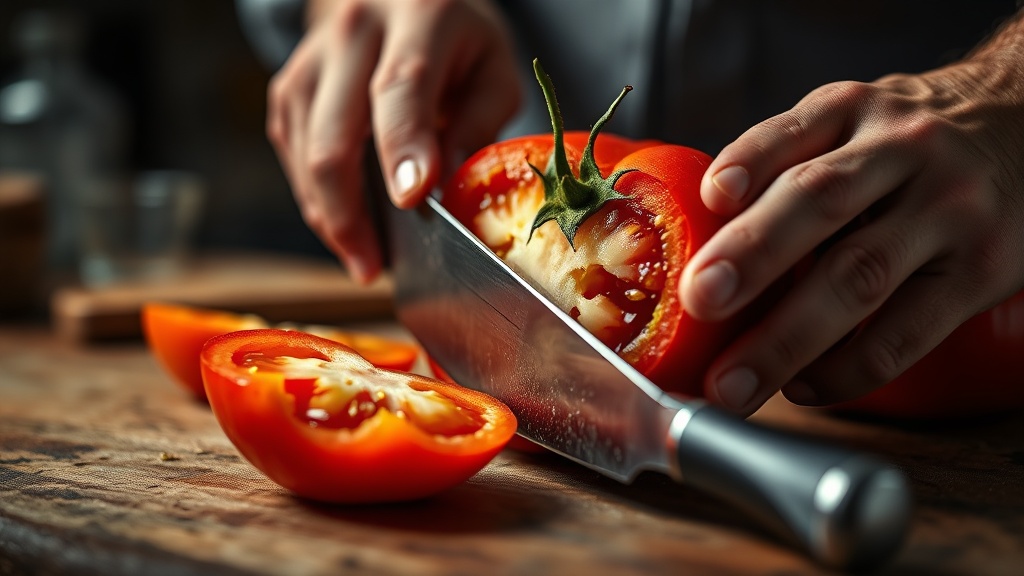
Why Does Your Sharp Knife Still Struggle to Slice a Ripe Tomato?

Why does your sharp knife still struggle to slice a ripe tomato? You've run the blade across a honing rod, maybe even taken it to a whetstone recently, yet that soft-skinned fruit still squishes under pressure. The issue isn't your technique at the cutting board—it's likely that your definition of "sharp" and your blade's actual edge geometry are having a quiet disagreement.
Most home cooks conflate sharpness with a single beveled edge, but commercial kitchens taught me otherwise. During my two years working the line, I watched veteran cooks touch up their knives every single shift—not because the knives were dull, but because different tasks demand different edges. A tomato skin, thin and taut with resistance, requires a toothier bite than a polished chef's knife delivers fresh from the stone. Understanding this distinction changes everything about how you maintain your most important tool.
What's the Real Difference Between Honing and Sharpening?
Let's clear up the confusion that keeps home cooks frustrated. Honing straightens the microscopic teeth along your blade's edge—teeth that fold and curl with normal use. A honing rod (that steel rod hanging in every kitchen supply store) doesn't remove metal; it simply realigns what exists. Think of it as combing hair back into place rather than cutting it.
Sharpening, however, is subtraction. Whether you're using a whetstone, a pull-through sharpener, or sending knives out to a professional, sharpening grinds away steel to create a new edge entirely. This distinction matters because over-sharpening wears your blade down prematurely, while under-honing leaves you fighting against a bent, ineffective edge.
The tomato test reveals the truth. A properly maintained knife should slice through skin with minimal pressure—if you're sawing back and forth or crushing the fruit, your edge either needs honing or has become too polished for the task. Japanese knives often arrive with a 15-degree angle per side, laser-thin and ideal for precision work. Western knives typically sit at 20 degrees, more durable but less aggressive. Neither is universally "better"—they're simply designed for different approaches to cutting.
How Often Should You Actually Sharpen Your Kitchen Knives?
The answer depends on your cooking frequency and what you're cutting. Professional cooks might touch up on stones weekly. Home cooks preparing dinner five nights a week? Every three to six months suffices for actual sharpening, with honing before each significant cooking session. But here's where the history teacher in me surfaces—this rhythm mirrors ancient maintenance practices.
Medieval cooks didn't have modern stainless steel. Their carbon blades required daily attention, often stropped on leather or touched up on fine stones. The samurai's relationship with sword maintenance transferred directly to Japanese kitchen traditions, where a cook's knife reflects personal discipline. European traditions developed around harder-wearing steels and heavier cutting tasks, leading to more forgiving (but less refined) edges.
Your cutting board matters more than most realize. Glass boards—still inexplicably popular—destroy edges within weeks. Bamboo, while eco-friendly, contains silica that dulls steel faster than end-grain hardwood. Plastic boards are middle-ground options, though they groove and harbor bacteria over time. The best choice remains end-grain maple or walnut: the wood fibers separate under blade pressure, then close back up, preserving your edge while being kind to the steel.
Reading the Signs Your Knife Sends
Pay attention to what your knife tells you during use. If it slips off onion skins rather than biting through them, the edge has rounded and needs sharpening. If it cuts but feels "sticky" or requires extra pressure, it likely needs honing. A sharp knife should feel almost effortless—if you're working harder than necessary, something's wrong.
The paper test provides immediate feedback. Hold a sheet of printer paper vertically and slice downward. A truly sharp knife catches immediately and slices cleanly. A slightly dull edge pushes the paper forward or tears rather than cuts. This test works across all knife types and requires no special equipment.
Can You Sharpen Knives Without Expensive Equipment?
Absolutely—though the method you choose shapes your results. Professional whetstones (water stones) remain the gold standard, offering control over grit progression and edge geometry. A basic setup requires only two stones: 1000-grit for sharpening and 4000-6000 grit for polishing. Total investment runs $40-80 for quality stones that last years with proper care.
Pull-through sharpeners tempt with convenience but remove steel aggressively and create specific edge geometries that don't suit all knives. They're acceptable for inexpensive supermarket blades but should never touch quality cutlery. Electric sharpeners operate similarly—fast but crude, trading your blade's longevity for convenience.
The Serious Eats guide to knife sharpening offers excellent visual instruction for whetstone technique. The key principles: maintain consistent angle, use the entire stone surface to prevent uneven wear, and progress through grits without rushing. Sharpening is meditative work—rushing creates wavy, inconsistent edges that perform poorly.
For those intimidated by freehand sharpening, guided systems like the Edge Pro or Lansky provide angle consistency through mechanical jigs. These systems work well and produce excellent results, though they're slower than freehand once you develop skill. They're also less portable—something to consider if you cook in multiple locations or need to maintain knives away from home.
The Strop: Your Secret Weapon
Leather strops loaded with fine abrasive compound put the final polish on any edge. Barbers have stropped straight razors for centuries; the technique transfers directly to kitchen knives. A few passes on leather after sharpening removes the microscopic burr left by stones and creates that "hair-popping" sharpness professionals chase.
You don't need fancy equipment—a piece of leather glued to a wood block works perfectly. Load it with green honing compound (available at hardware stores for under $10) and strop away from the edge, not into it. Five passes per side after sharpening extends edge life dramatically and gives you that effortless slicing ability that makes cooking genuinely enjoyable.
Why Do Different Knives Need Different Approaches?
Your paring knife, chef's knife, and serrated bread knife share little beyond their kitchen purpose. Each requires specific maintenance approaches that respect their design intentions.
Paring knives see rough handling—coring apples, hulling strawberries, detailed work that chips fine edges. These benefit from slightly sturdier geometries (20 degrees rather than 15) and more frequent touch-ups. Chef's knives, being generalists, can go either way depending on your cutting style. Rock-choppers need durable edges; slicers can run thinner.
Serrated knives rarely need sharpening—perhaps once every few years with normal use. The points do the cutting while the gullets protect the edge from contact with the cutting board. When they do dull, specialized tools or professional service work best; attempting freehand sharpening on serrations destroys their geometry.
Japanese single-bevel knives (yanagiba, usuba, deba) require specialized knowledge and dedicated stones. These traditional blades have concave backs and specific bevel angles honed through years of training. If you own these, you likely already know their maintenance requirements—or should learn before investing further.
The Korin Japanese knife sharpening guide provides exceptional detail for those exploring traditional Japanese maintenance techniques. Their video demonstrations capture subtleties that text alone cannot convey.
Carbon steel knives—favored by many professionals for their extreme sharpness—demand additional care. They patina (develop protective oxidation) and will rust if neglected. Wiping them dry immediately after use becomes ritual. Some cooks force a patina with mustard or vinegar to establish immediate protection. These blades sharpen more easily than stainless but require more attention overall.
Modern powder metallurgy steels (SG2, R2, ZDP-189) offer extreme edge retention at the cost of sharpening difficulty. These knives stay sharp longer but require more time and better stones when they eventually dull. They're excellent for cooks who hate maintenance but demand performance—provided you accept the trade-off when sharpening day arrives.
Your knife represents a relationship, not a purchase. The two years I spent in professional kitchens revealed that cooks who maintain their blades personally develop intuition about edge condition that translates directly into better cooking. You learn to feel when steel bites properly, when it slides where it should catch, when resistance suggests the wrong angle or a dull spot. This tactile knowledge separates competent home cooks from those who truly understand their tools.
That tomato waiting on your cutting board? It's a test. With the right edge geometry and proper maintenance, it should yield effortlessly—no crushing, no sawing, just clean separation between flesh and board. When your knife performs at that level, everything in the kitchen becomes more enjoyable. The prep work stops being work at all.
Start with one good knife and learn its maintenance thoroughly before expanding your collection. A single well-maintained eight-inch chef's knife outperforms a block full of neglected blades. The history of cooking is written by people who respected their tools enough to maintain them properly—from medieval apprentices to modern line cooks, that relationship between hand and edge remains unchanged.